

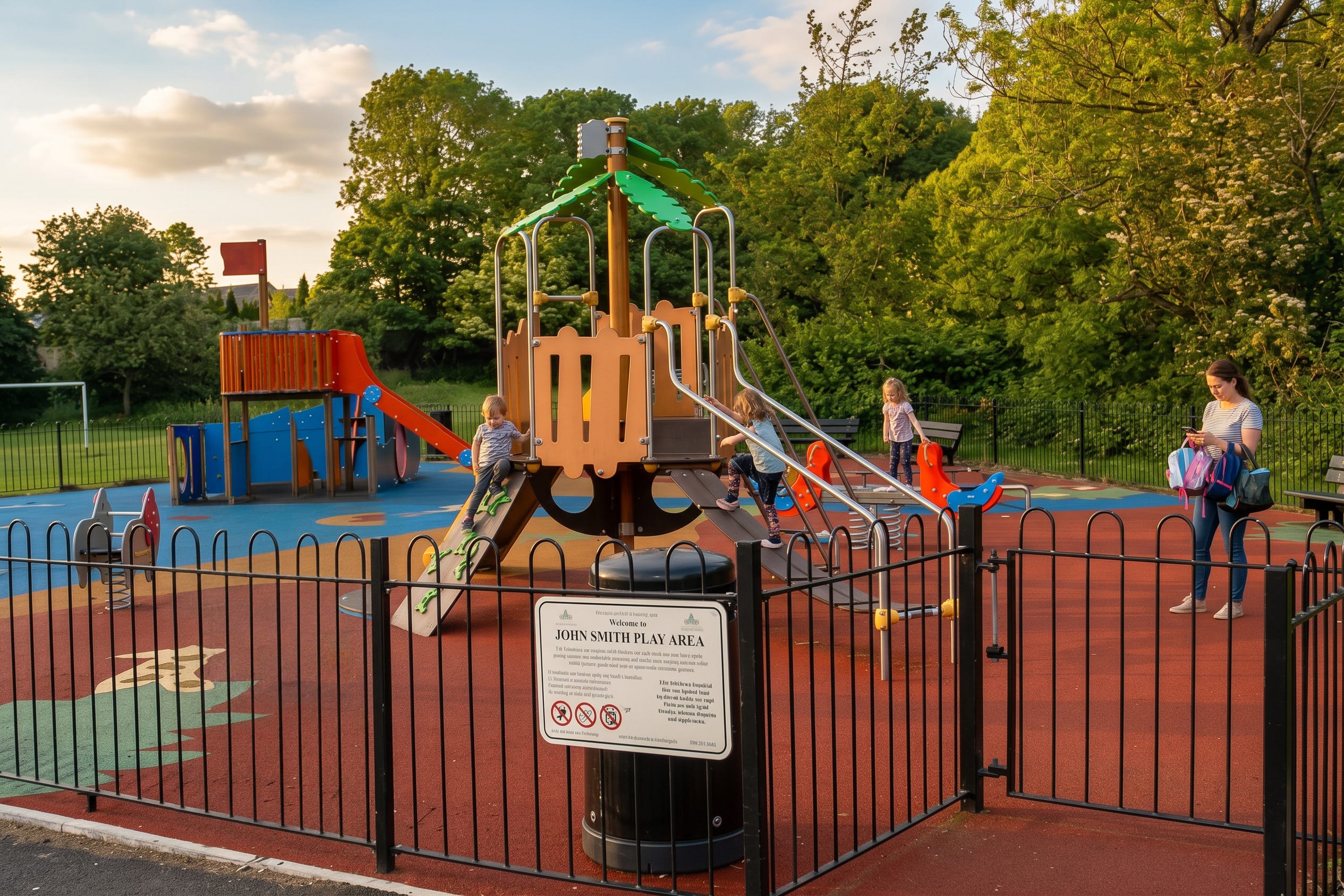
You probably know the walk. Past the parked cars, down a hedge-lined laneway with not a soul in sight and nobody to notice if something went wrong, past the tennis courts and the bins to the far corner, where a small playground waits behind a low fence. I’ve walked it in more suburbs and towns than I can remember, and so often we’ve been the only ones there, on weekdays while the older children are at school, and in the evenings as the light fades. On a grey winter afternoon, it can feel like the loneliest place in town.
Now step into a busy town square. People, chatter, someone always within sight. No one is in charge, yet somehow you feel looked after.
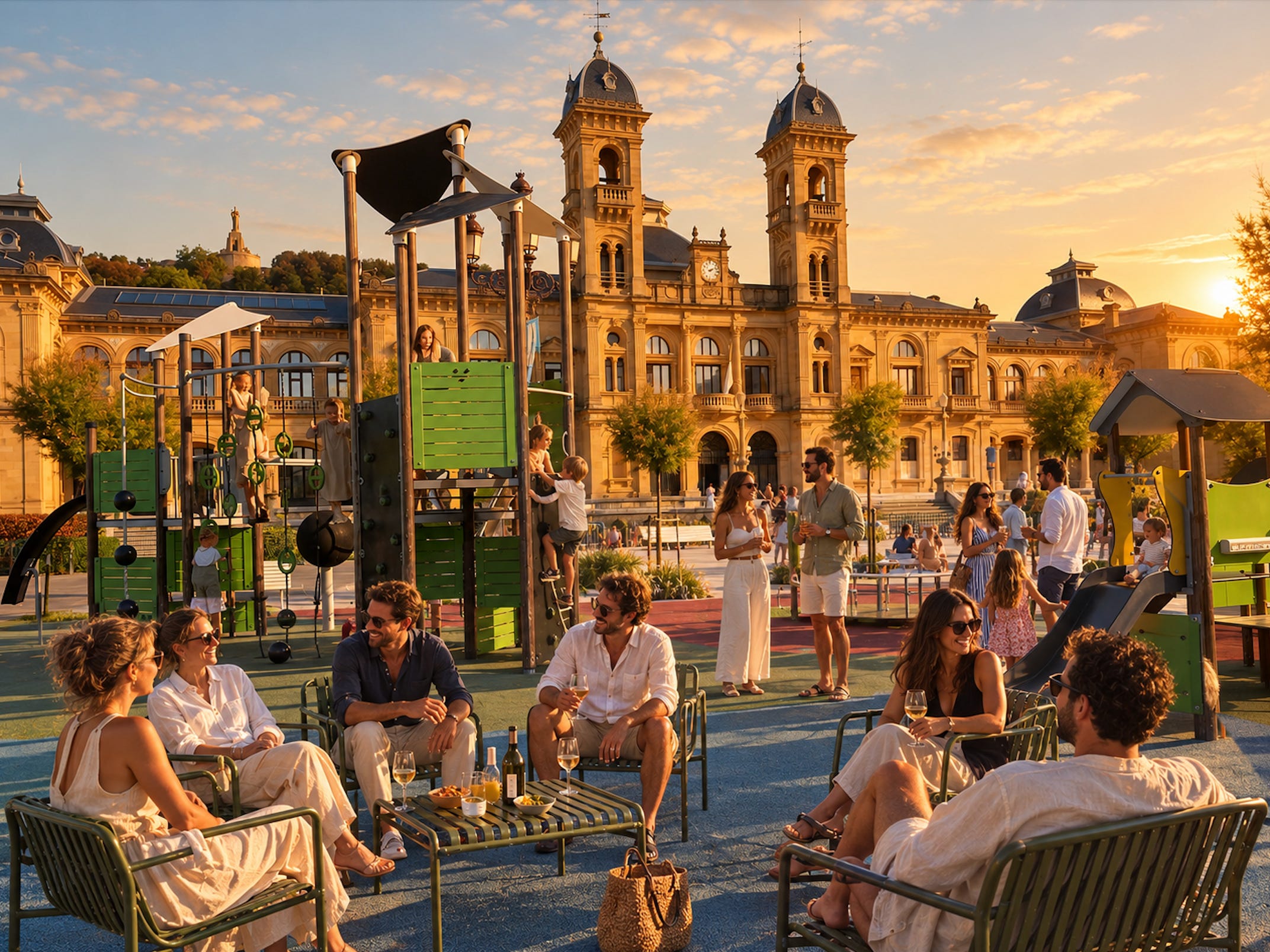
Memorable family afternoons in San Sebastián, Bilbao and Marsaskala have really stayed with me. Families were sitting out at the cafés and little bars around the square, parents, grandparents, aunts and uncles, all talking over each other. And right in the middle, the kids were playing until well after dark, in full view of everyone. There was no fence, and no need for one. I’ve felt that same wonderful buzz in so many European towns since, and I miss it every time I’m back in a typical suburban setting. Some of that is weather and culture, of course, but as an architect I can’t help seeing how much of it comes down to design.
The playground at the back of the park
Nobody sets out to hide children away. So how did we end up here?
It started with good intentions. Britain’s first public playgrounds appeared in Manchester and Salford’s parks in the 1840s, as outdoor gymnasiums for fresh air and exercise, back when parks were seen as the healthy lungs of crowded industrial cities. Then came the car, and with it real momentum to move children off increasingly dangerous streets and into separate play areas. Equipment makers did the rest, and we ended up with the assumption that parks include playgrounds, and playgrounds include kit. One historian even notes that early playgrounds seemed designed to keep children conveniently out of sight.
The model travelled, too. New Zealand and Australia inherited British planning ideas, especially the garden suburb, with its large reserves and big sections and the dream of the quarter-acre block. When you give every family a large back garden, it’s easy to see how everyday play moved into the backyard, while public play went out to the reserves and the far end of the sports field.
Those reasons may have made sense at the time but I don’t think that they should still be deciding where our children play. Yet the habits have stuck. Play still tends to get whatever land is left over and then a fence, along with some uninspiring catalogue equipment and the usual rubber surfacing. The landscape researcher Helen Woolley calls it the “Kit, Fence, Carpet” approach, which I think is brilliant.
The good news is that it’s changing in places. In Sydney, the epic Darling Harbour playground is the centrepiece of a whole precinct of cafés, restaurants and green space, and Auckland’s Wynyard Quarter has turned an old industrial waterfront into a place where restaurants line the walkways and playgrounds keep thousands of children busy. But in many towns, play, and so parents too, are still kept on the periphery, and town centres are designed for the annual parade or the weekly market rather than everyday family life.
The trouble is that isolated places rarely feel safe, even when nothing is wrong. Researchers at the University of Leeds found that empty parks, especially after dark, felt unsafe even without any obvious threat, and that parks with more people in them feel safer. In architecture we call this passive surveillance: the everyday eyes of shopkeepers, neighbours and passers-by that quietly keep a place safe. The playground at the back of the park has almost none of it. Last week, in Hidden in Plain Sight , I wrote about the tucked-away corners of school grounds that leave children out of view. Playgrounds are so often the same: isolated spaces, away from the safe eyes of the community.
So often I’ve ended up standing on my own by the fence, waiting a little anxiously for my child to finish playing and yet at a town square café I can sit in a comfy seat and watch my child play, with people all around me. Some days I like to join in, while other days I’m too tired and just want a quiet coffee or chat with a friend while the children play. I know that time with my child is always a privilege, wherever we are, but being among other people fills my own cup too, and that’s good for both of us.
I know that I’m not the only one who feels this. Over half of parents with children under five feel lonely at least some of the time, according to Coram Family and Childcare, and what helps most is doing things locally with other parents.
What integrated play looks like
What gives me so much hope is that the better model already exists. As an architect who works mostly remotely these days, I’ve been lucky to travel a lot. Ten years ago, I often travelled with my niece whenever my sister had international meetings and events around the globe, looking after her during the day and working at night. Later, when I had my own family, this flexible work model allowed us to travel a lot, and together we explored every museum and playground we could find. Without really meaning to, it’s become years of informal research, from Budapest and Bonn to Sydney and Seattle, and it has completely changed how I design for families. Here are a few places that have stayed with me most.
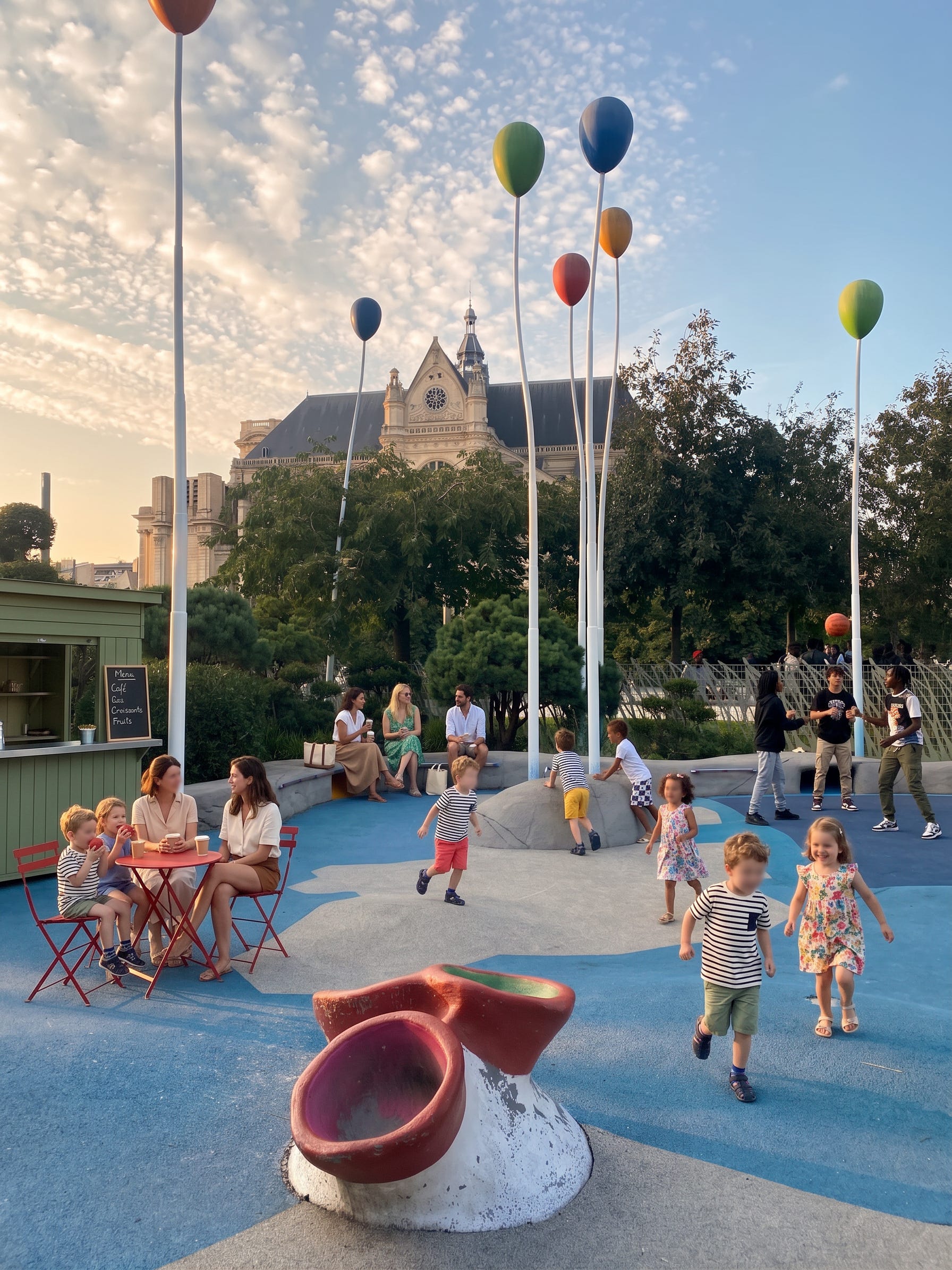
Paris: a forgotten corner, reborn. When I lived in Paris, the area around Les Halles felt a little unsafe, somewhere you hurried through rather than lingered. So I was pleasantly surprised, years later, to find the new Jardin Nelson Mandela bursting with life. It’s completely open, with views over the beautiful old Saint-Eustache church and the Bourse du Commerce, and it’s full of children of every age: little ones scrambling through the adventure playground, older kids shooting hoops on courts painted in swirls of blue and orange by the street artist Romain Froquet. And the best part? Those courts are there because local secondary school pupils started a petition, gathered around 400 signatures, and the city funded their idea. If you ever needed proof that a community can change a place, this is it.
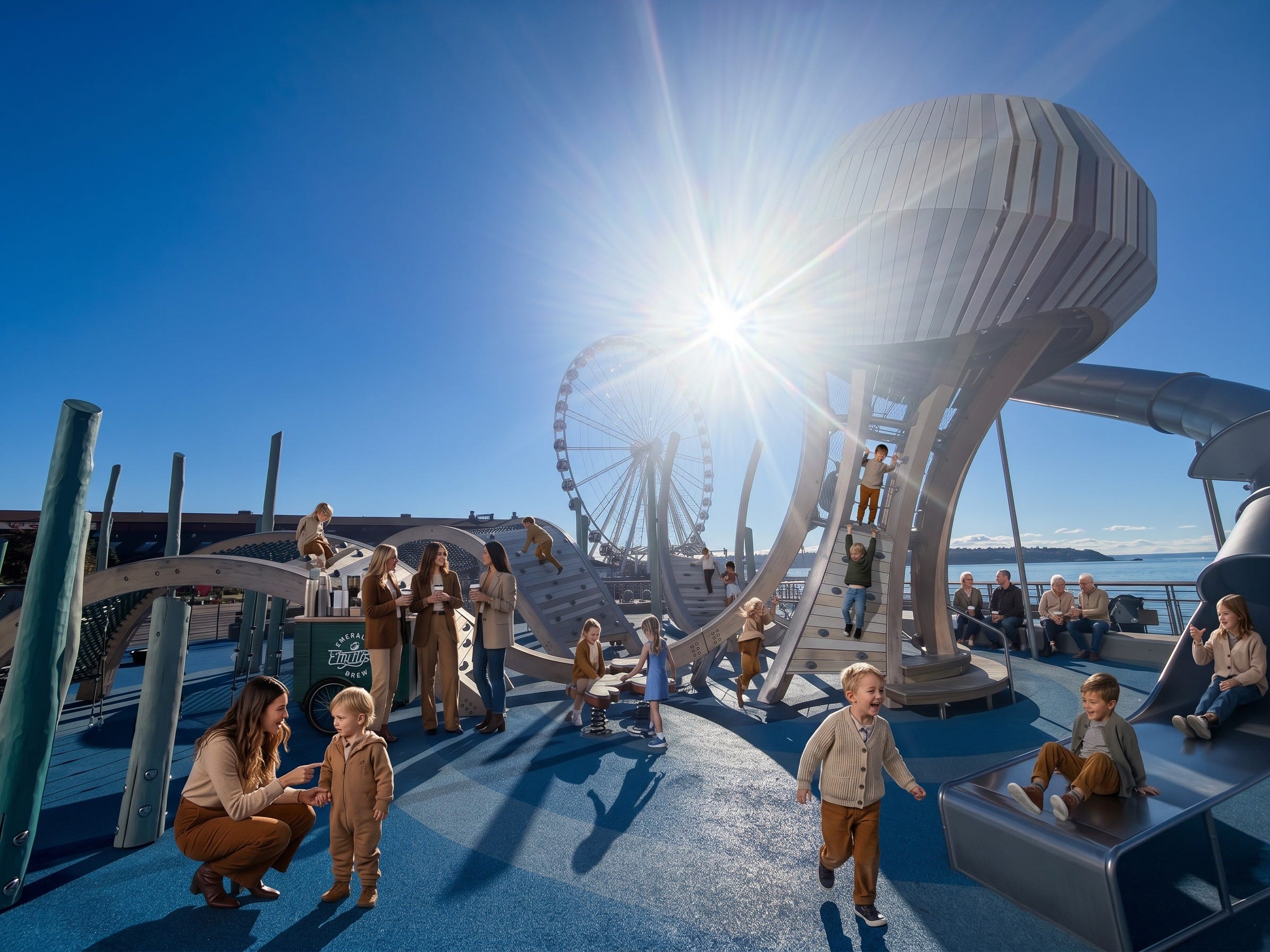
Seattle: from motorway to waterfront. I used to explore Seattle a lot with my niece when she was a toddler and finding good play spaces in the centre was rare, but the city has changed a lot since then. An elevated highway once cut downtown off from its waterfront. It came down in 2019, and in its place is a 20-acre park along the shore. From the photos my sister sent me this month, what catches my eye is the new Pier 58 playground, with its giant jellyfish climbing tower, right on the waterfront and clearly visible from all sides at all times. I can’t wait to see it for myself.
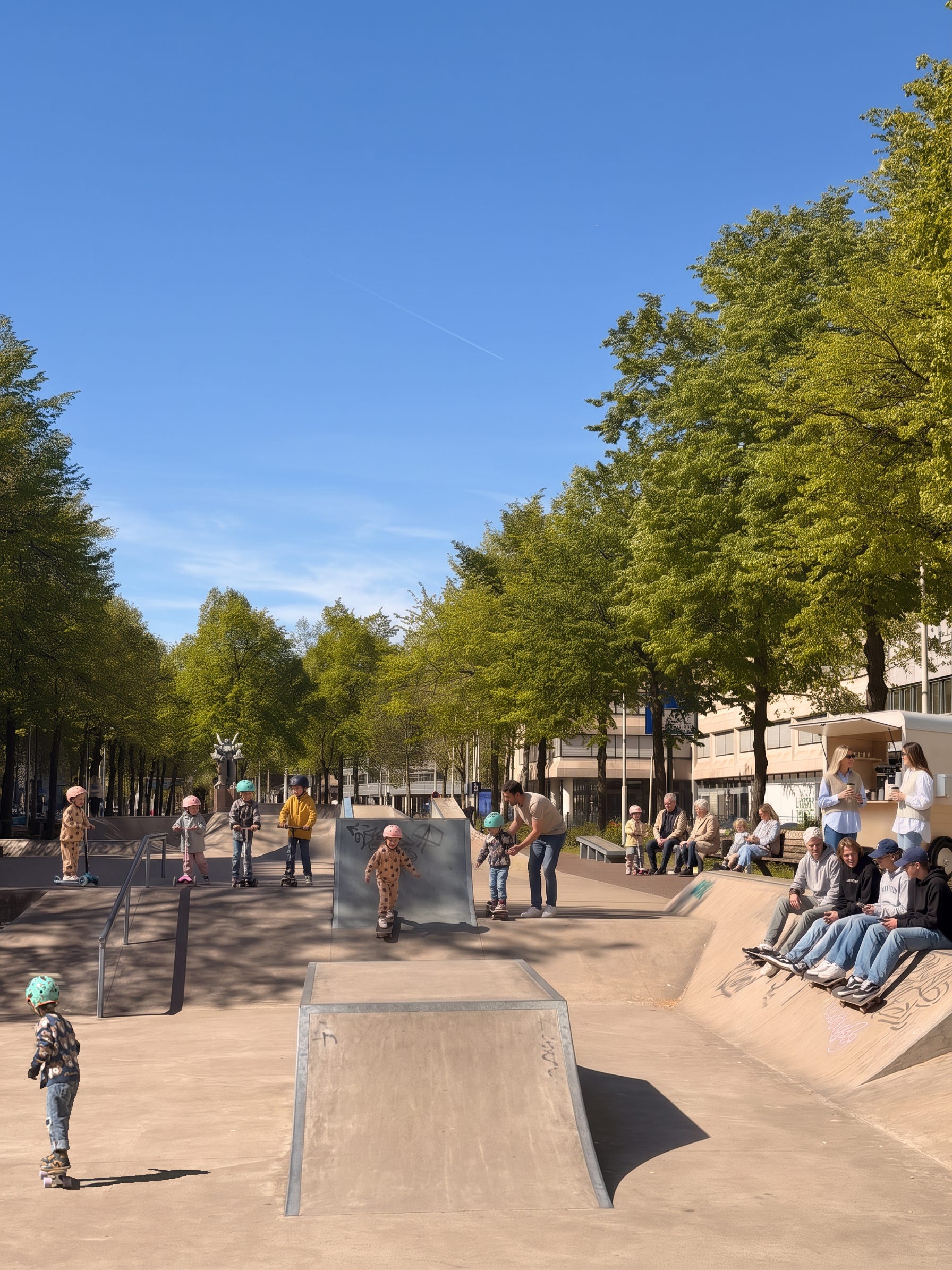
Rotterdam: play in the middle of the road. In 2000, the empty central strip of Westblaak, a main road through the centre, became a skatepark, and the idea came from young skaters themselves. Most towns push skaters to the edge of town. Rotterdam put them in the middle of everything, and that whole stretch of the city came alive. When we stayed there, we walked along it every day, sometimes more than once, happily chatting over our morning coffee while the kids rode around.
Bilbao: where café and playground blur. Down by the river there’s a huge open playground with a café that sprawls right into it, so you honestly can’t tell where one ends and the other begins. As a designer I love that blurred edge, and as a mum I love it even more, because nobody has to choose between their own time and their children’s. And Bilbao gets plenty of rain, so the city is now putting roofs over playgrounds rather than giving up on them. The weather isn’t much of an excuse, wherever you live.
San Sebastián: play on the everyday walk. The city’s most-used playground, Alderdi Eder, sits right in the centre, between the town hall and the bay. It’s not somewhere you make a special trip to. It’s just part of the walk, which is how play should be. See image at top of article.
What all these places share is a willingness to put children right where life is already happening.
And notice something else. In almost every one of these places, play didn’t just fill a space, it brought a tired or forgotten one back to life. Rotterdam woke up a strip of road everyone ignored, and Paris turned a corner people hurried through into somewhere they linger. In Sydney, the Darling Harbour playground replaced an entertainment centre that had never really worked, and now families keep coming back, drawing customers to the shops, cafés and bars around it. Well-designed play isn’t a nice extra for a town centre. It might be one of the best tools we have for bringing one back to life.
Closer to home: the market town
Think of a typical English market town. Its square fills up for the Remembrance Sunday parade and on market days, and those things matter. But walk through on an ordinary weekday and it’s paving, a bandstand and people cutting through on their way somewhere else. The nearest playground is off in the park. You could say the same of plenty of town & suburban centres in New Zealand and Australia, too. Imagine how life could be different:
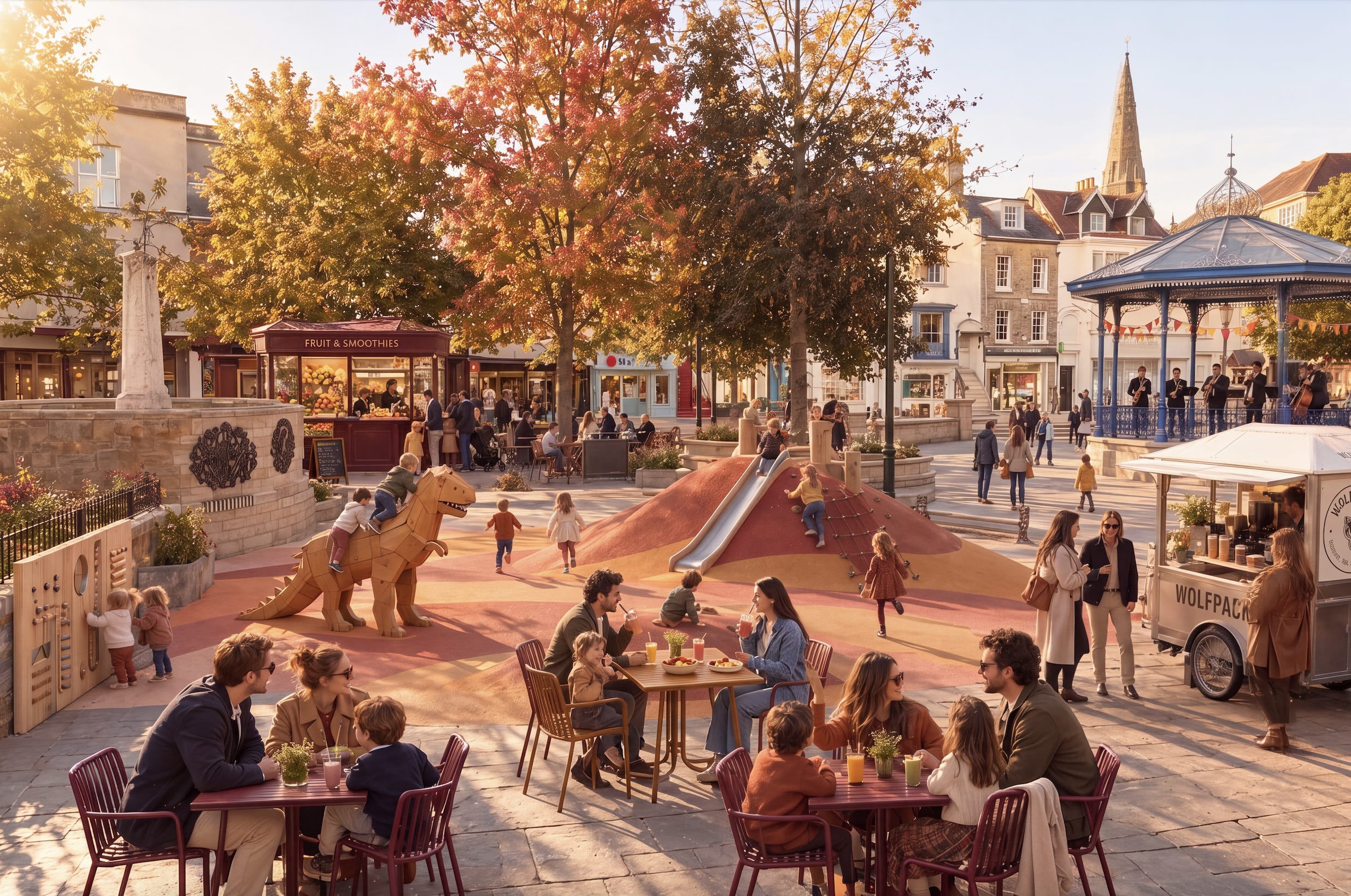
Instead of constantly telling your child to sit still or not climb on that stone memorial for the hundredth time, imagine we actually catered for children and provided play spaces where the people are. While this image has been created for illustrative purposes only, a real integration of play areas would undergo careful study to ensure that the key town area activities are not disrupted and also to retain important historical features such as memorials and bandstands. Also it would be nice for the playground to conceptually tell a story and be meaningful to the town itself.
I’m not trying to turn a civic square into a playground. I just want it designed for everyday life as well as the special occasions. Done well, you can accommodate it all: the remembrance service, the market, and a Tuesday morning with a toddler.
Making room for everyone
I’m not proposing we get rid of park playgrounds. They’re still a wonderful resource for families, especially when there are other people around, and a chance for all of us to get some fresh air and exercise. Children need trees and mud and quiet corners too, and some find busy places overwhelming. I just believe that park playgrounds should feel safer, and offer much better amenities for the parents, friends and relatives who come along too. We need both. And it can work the other way round, too, by bringing a bit of the town to the park with a coffee cart or a little kiosk right in the play area.
There are real questions to work through, of course, like traffic, noise and maintenance. Van Eyck himself warned that playgrounds need constant care to survive. But these are design problems, and design problems can be solved.
And surely this is money well spent. A great space where families come together gives back so much: healthier, happier children, parents who feel less alone, neighbours who actually know each other, and town centres that feel alive and safe. I can’t think of many investments that give back so much, to so many people, every single day.
How you can make a difference
Most of us can’t simply choose a better playground. We’re stuck with what our town gives us. But together, we can change it.
Use the square. Take a ball, some chalk or a scooter into town on an ordinary afternoon. The more families are seen there, the stronger the case for designing for them.
Organise a pop-up play day. Bring loose toys, chalk and blankets into the square with other parents. It costs almost nothing and shows everyone what the space could be.
Talk to local cafés. Ask them about seating facing the play, a family morning, or a coffee cart at the park. Families are good business.
Start a kiosk yourself. If there’s nothing by your playground, ask the council about running one, as a small business or a community kiosk that lends out toys.
Speak up. Join a “Friends of” group, respond to town centre consultations, and ask your councillor to make play part of the town centre plan, not just the parks plan.
Raise the money. Set up a fundraising page, or look into community grants and civic crowdfunding platforms like Spacehive.
Ask your children what would make them want to stay. Their answers are often the best brief of all.
And if you work for a council or in planning, a few questions for your next town centre project:
Is play part of the town centre brief, or only the parks brief?
Could a square host play every day and still clear easily for markets and ceremonies?
Have children, teenagers and parents, including teenage girls, been asked what would make them stay?
Is there a plan and budget for looking after it in ten years’ time?
Play in plain sight
Children belong in plain sight, in our schools and in our towns. Tuck play away at the back of the park and we’re telling children, and the people who love them, that they belong somewhere apart. Bring it into the square and we’re telling them they’re part of the life of the place.
Aldo van Eyck once wrote that if cities aren’t meant for children, they aren’t meant for citizens either. I’d love to see our town squares designed for the everyday, for the Tuesday morning as much as the parade. Because the best places for children are the ones that work for the whole family, where everyone’s cup gets filled.
Next week: why it takes a village, and how the places we share can help us build one.

About Spaces Where Families Thrive
I’m Jo Aitken, architect, designer, traveller and mama, with over 20 years of experience working on public places, schools and homes across four continents. I believe that the places we share can shape how our families live, play and connect, and that together we have far more power to change them than we think. Each week I share stories, research and practical ideas to help us create spaces both public and private where families thrive, not just children, but everyone who loves them.
If that’s something you care about too, please subscribe, share this with a friend, and tell me in the comments what you’d love to change where you live.
GO DEEPER
Spaces Where Families Thrive by Atelier Aitken
When you’re ready, here are three ways to bring these ideas into your own spaces:
FOR YOUR HOME
Family home design: Calm, playful homes for families with young children, designed to grow with your family and still feel beautifully grown-up. Get in touch
FOR SCHOOLS, CAFÉS, HOTELS AND PUBLIC SPACES
Spaces for children and families: Specialist design consultation for the places children use, from nurseries, schools and libraries to cafés, restaurants, hotels and town squares. Designing well for children doesn’t mean designing in a childlike way. Happy kids make happy parents, and a better experience for everyone. Book a consultation
FOR ANY PROJECT, ANYWHERE
Atelier Aitken: My international architecture and design practice, offering concept and developed design for homes, schools, workplaces, hospitality and retail, wherever you are in the world. See my work
For more thoughts and design ideas, you can follow along on my Instagram account here
Sources
Three Centuries of London’s Playgrounds (London Gardens Trust)
The first playgrounds were for adults, not kids (Popular Science)
When parks don’t feel like safe public spaces (University of Leeds)
Designing parks to help women feel safe (University of Leeds)
Over half of parents with young children feel lonely (Coram, 2019)